Ethereal margin: cross-margin risk before closure
Ethereal margin pooled USDe collateral across perpetual positions within each subaccount, linking liquidation risk to shared equity while limiting the funds available for new orders and withdrawals. Its markets have closed, so users need to withdraw any remaining exchange funds. The former trading rules explain how position losses, reserved collateral, and funding affected an account. They also explain why total equity and the amount available to withdraw could differ.
Market closure changed the decision for remaining balances
Remaining exchange funds need the withdrawal route now that Ethereal’s markets have closed. The app also directs users to transition to Meridian. The selected subaccount’s available balance identifies the collateral that can support a withdrawal request. A past leverage setting describes the former trading configuration, while the recoverable amount comes from the remaining account state. Controls for opening new positions belonged to the exchange’s earlier trading phase.
A withdrawal amount must fit within available margin. Destination support and withdrawal enablement also matter, because these settings govern whether the requested transfer can proceed. Cross-chain processing time varies with the destination. Once a withdrawal request is processed and its amount deducted, that pending transfer is separate from the balance still in the subaccount.
Subaccount equity determined the shared risk boundary
Positions within a cross-margin subaccount drew on the same collateral pool. A loss on one position reduced the equity that supported the others. The liquidation test compared that shared equity with the combined maintenance requirement across open positions, making the account’s aggregate exposure relevant to every individual trade.
Each market contributed its own required margin. A position’s size and mark price determined its notional value, while the market’s maintenance fraction determined its contribution to the threshold. The combined requirement therefore reflected the positions that actually remained open.
A profitable position could still enter liquidation with the rest of its subaccount. Its own gain didn’t give it a separate protected collateral allocation.
A subaccount had its own positions and balance. Funds elsewhere under the same wallet didn’t automatically enlarge that account’s shared margin pool.
Position size changed both margin requirements
Initial and maintenance margin answered different questions: whether collateral was sufficient to open exposure, and whether equity remained sufficient to keep the resulting positions open. Both depended on market configuration. A leverage maximum was a parameter for a particular market, not one permanent limit covering every Ethereal contract.
The initial requirement
Exposure at the mark price
Position notional was absolute position size multiplied by mark price. The fraction applied to that exposure, so larger positions required more collateral under unchanged settings.
The applicable leverage limit
At a market maximum leverage of L, the documented minimum initial margin fraction was 1/L. This described the minimum collateral requirement at that limit. It didn’t mean that every funded subaccount operated at maximum leverage.
The maintenance requirement
The documented maintenance fraction was 1/(2 × L), with L representing the market’s maximum leverage. Multiplying that fraction by position notional gave the position’s maintenance requirement. Across multiple positions, the account test used the combined requirement. Historical calculations need the settings that applied to the relevant market and event.
Mainnet alpha determined which profits were usable
Mainnet alpha excluded unrealized gains from the margin available for new trades and withdrawals. Unrealized losses reduced available margin. This configuration made an open gain and a spendable balance materially different account states.
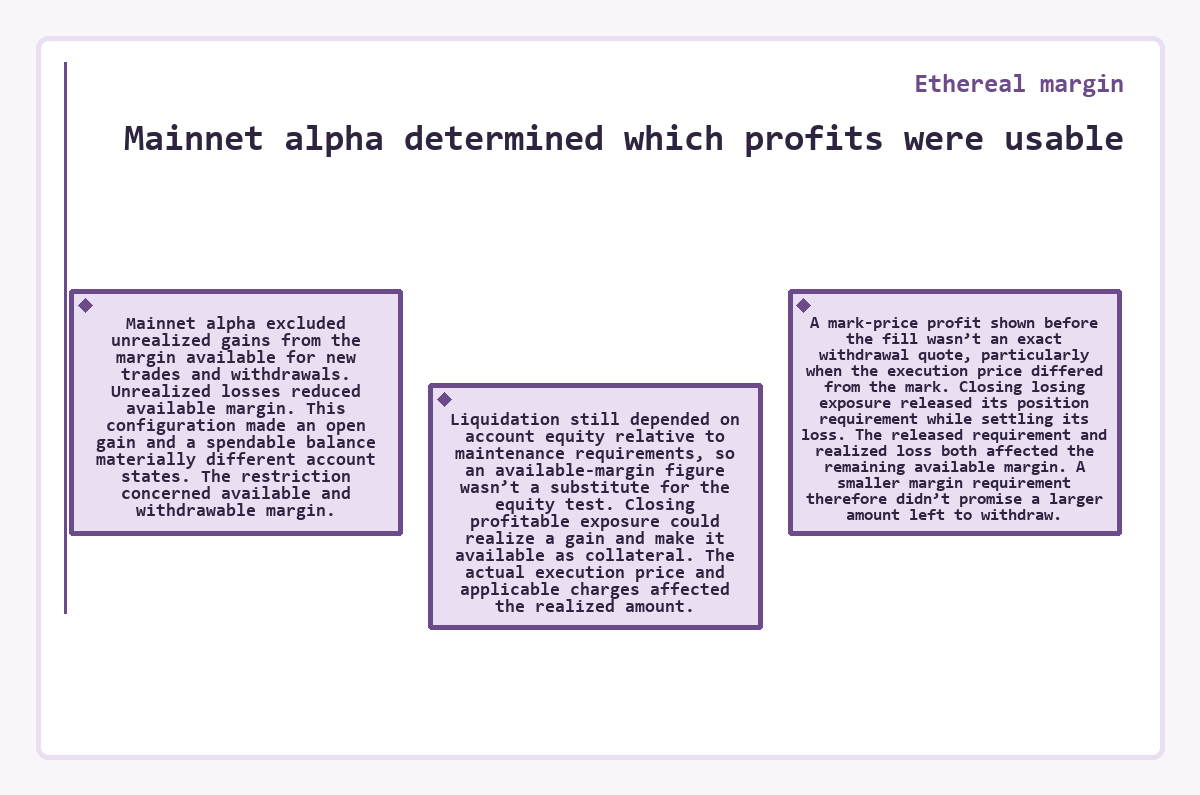
The restriction concerned available and withdrawable margin. Liquidation still depended on account equity relative to maintenance requirements, so an available-margin figure wasn’t a substitute for the equity test.
Closing profitable exposure could realize a gain and make it available as collateral. The actual execution price and applicable charges affected the realized amount. A mark-price profit shown before the fill wasn’t an exact withdrawal quote, particularly when the execution price differed from the mark.
Closing losing exposure released its position requirement while settling its loss. The released requirement and realized loss both affected the remaining available margin. A smaller margin requirement therefore didn’t promise a larger amount left to withdraw.
Unfilled orders changed available collateral
A resting order could reserve collateral before it filled. Ethereal’s available-margin calculation accounted for position requirements, order reserves, and unrealized losses alongside the total balance. Canceling an open limit order released the reserve for its unfilled portion. Cancellation didn’t reverse completed fills. Those fills could have increased, reduced, or closed a position, so a canceled order could still leave open exposure.
Funding and execution determined the net balance
Funding settlements changed collateral even when position size stayed constant. In the former perpetual configuration, funding was calculated and applied hourly. Positive funding transferred value from longs to shorts; negative funding reversed that direction. A funding debit could reduce equity enough to cross the maintenance threshold.
Trade execution introduced another distinction between expected and settled amounts. Position history recorded fill prices, sizes, and fees, while funding records explained payments associated with holding exposure. Those records served different accounting purposes. Releasing a position’s margin requirement didn’t refund earlier trading fees or funding debits. The net balance reflected realized trading results and the charges that actually applied, so the collateral originally committed to a position wasn’t necessarily the amount left afterward.
Oracle updates changed liquidation exposure
Ethereal used Pyth Lazer oracle prices to assess margin liquidation risk. The mark price fed the risk calculation, while order-book prices governed trade execution. A last-traded price on a chart and the oracle mark could therefore describe different conditions. This distinction mattered when comparing an account’s displayed liquidation exposure with the price at which a reducing order might fill.
The same oracle reference also contributed to funding calculations. Its role in measuring market prices didn’t turn it into an execution guarantee. Closing exposure depended on the order’s conditions and available liquidity, while liquidation depended on the account’s margin condition. A favorable last trade didn’t establish that shared equity remained above maintenance.
The maintenance breach triggered a complete takeover
Equity below the combined maintenance requirement triggered takeover of the entire affected subaccount. It canceled open orders, transferred every position to the liquidator at the bankruptcy price, and set the trader’s margin balance to zero. It then recorded the action onchain. The liquidator unwound the transferred exposure afterward; any surplus stayed in the insurance fund, which absorbed deficits. This wasn’t a partial liquidation limited to whichever position had suffered the largest loss.
Onchain settlement checked oracle-price freshness, position consistency, and equity below maintenance. A failed check reverted the liquidation transaction. These checks concerned whether the takeover could settle correctly. The insurance fund handled losses from the transferred positions; it didn’t promise to restore the liquidated trader’s collateral.
Earlier margin actions required different account states
The trading phase offered several ways to change collateral use or exposure. Each required a different starting state. Deposits, cancellations, and position exits below describe that earlier configuration; the closure notice directs remaining users toward withdrawals. The withdrawal variants also remain conditional on the route and token settings that actually support the transfer.
| Margin action | Required account or route condition |
|---|---|
| Add collateral to an existing subaccount | USDe ready for an enabled deposit route; confirmation before trading availability. |
| Fund a separate subaccount | A distinct subaccount name and an initial deposit for its own margin pool. |
| Cancel an unfilled limit order | A resting order whose unfilled quantity still reserved collateral. |
| Reduce an existing position | An open position and an executable reducing order; a reduce-only order couldn’t increase or reverse the position. |
| Use a market close order | An open position and resting liquidity; the order sized itself to the position and canceled resting or untriggered orders before attempting the close. Any unfilled quantity was canceled. |
| Withdraw to the wallet on the Ethereal appchain | Withdrawable funds, withdrawal authorization, and finalization after the configured lockout. |
| Withdraw across chains | Sufficient available margin and a supported destination for outbound delivery. |
| Common boundary | A collateral transfer, order cancellation, and position fill changed different account objects. |
Canceling an order acted on its remaining instructions. Reducing or closing a position acted on executed exposure. A withdrawal acted on funds leaving the subaccount. These distinctions explain why the same balance could require a different action depending on whether collateral was reserved, supporting a position, or already committed to withdrawal.
Separate subaccounts differed from isolated position margin
A separate subaccount isolated its margin pool from other subaccounts. Isolated position margin would instead assign collateral to an individual position within an account. Ethereal’s documented trading app used cross margin by default, and that app description stated that isolated margin wasn’t yet available. The protocol’s design for both modes didn’t establish that the interface offered both choices.
Funding another subaccount therefore changed the boundary between account pools without changing cross margin into per-position isolation. Multiple positions inside that new subaccount still shared its collateral. Their combined maintenance requirement remained the relevant risk test, and a liquidation affected that subaccount’s full position set. A BTCUSD position remained derivative exposure supported by its subaccount’s USDe margin.
Common questions about Ethereal margin
Did Ethereal’s stop-loss orders guarantee protection against cross-margin liquidation?
A stop-loss didn’t guarantee an exit price or prevent every cross-margin liquidation. A stop-market order triggered from the oracle mark and then faced the market’s execution conditions. Slippage could change the realized loss, and an order could remain unfilled if market conditions exceeded its tolerance. Because liquidation depended on shared subaccount equity, losses elsewhere in the same pool also mattered.
Could USDe balance rewards cover an immediate Ethereal margin shortfall?
An estimated balance reward wasn’t immediately available collateral. The former reward program used balance snapshots and distributed rewards through Merkl, separately from the exchange’s instant margin calculation. An expected distribution therefore didn’t increase the funds that were already available inside a subaccount. Reward eligibility and the collateral available to support open positions were different conditions.
Was an Ethereal linked signer permitted to withdraw collateral?
A linked signer couldn’t withdraw Ethereal margin funds. Its delegated permissions covered order submission, cancellation, and access to non-public subaccount information. The primary wallet retained withdrawal control. This distinction remained relevant to authorization even when the same signer had previously managed the account’s trading activity: permission to place an order didn’t include permission to move collateral out of the exchange.
Why could an Ethereal withdrawal remain pending after the margin balance fell?
The documented withdrawal process deducted funds when the request was processed, before onchain relay and finalization. A lower subaccount balance therefore didn’t establish that the wallet had received the payout. Native finalization followed the configured lockout, while cross-chain delivery involved its destination route. Transfer status and finalization records identified progress separately from the balance deduction.
Does a perpetual market’s base asset count as Ethereal collateral?
A perpetual market’s base asset didn’t automatically qualify as depositable collateral. Ethereal distinguished concrete tokens, which represented actual transferable assets, from virtual tokens that identified derivative market exposure. Its launch configuration used USDe collateral. Future plans for additional collateral and portfolio margin didn’t establish that those assets were accepted in the configuration of a particular account or historical trade.
updated