Ethereal combined USDe margin rewards with perpetual futures before its markets closed
Ethereal was a decentralized exchange that paired USDe collateral with perpetual futures, derivative contracts for long or short price exposure. Its markets have closed, and the app now directs remaining users to withdraw funds and transition to Meridian. The platform used an order book and separate trading subaccounts during its trading phase, with USDe rewards linked to account balances and qualifying positions alongside a broader ambition for a DeFi app. Its wider product plans included spot trading and money markets. The original exchange’s margin rules, network configuration, and reward programs describe its former operation; they don’t establish the terms of successor products.
Bottom line: Ethereal’s markets have closed, and its app directs remaining users to withdraw funds and transition to Meridian.
Market closure changed the task for remaining accounts
An introduction in November 2024 described a USDe-centered trading application, and Season Zero pre-deposits followed in February 2025 before private testnet access in April and public testnet access in June. The subsequent mainnet rollout distinguished restricted alpha access through a waitlist from a planned public beta. The app’s closure notice now directs users toward Meridian, so the earlier access arrangements don’t describe a way to start new trades on Ethereal.
USDe connected account balances to perpetual exposure
USDe provided the collateral behind positions, while each perpetual contract tracked exposure to an underlying market. Going long expressed exposure to rising prices; going short expressed exposure to falling prices. Neither position required owning the underlying asset. The contracts had no scheduled expiry, although liquidation and position closure could end exposure. Margin, funding payments, and trading profit or loss belonged to the exchange’s accounting system. This made the collateral balance central to the trading account even when the selected contract tracked a different asset.
Market specifications included BTCUSD, ETHUSD, and SOLUSD perpetuals. Their base assets described market exposure, not automatically a token balance available for withdrawal.
The token model distinguished concrete ERC-20 assets from virtual market assets. Concrete tokens had blockchain addresses and could support deposits and withdrawals when enabled. Virtual tokens represented assets within the exchange’s market accounting. At launch, USDe was the depositable collateral, and the roadmap placed additional collateral support in later releases.
The appchain linked order matching with onchain accounting
An application-specific sequencer handled order matching, while the appchain supported the exchange’s onchain accounting. The deployment used an Ethereum Virtual Machine (EVM) environment with Arbitrum execution, settlement through Arbitrum One, and Celestia data availability.
The original mainnet implementation used these settings. Account prerequisites and network requirements applied at different layers.
| Parameter | Documented setting | Function | Required context |
|---|---|---|---|
| Margin asset | USDe | Collateral for perpetual positions | A confirmed subaccount balance |
| Default margin mode | Cross margin | Shared collateral within a subaccount | Positions in the same subaccount |
| Funding interval | Hourly | Funding charges on open positions | A position subject to the funding event |
| Mainnet chain ID | 5064014 | Identification of the original appchain | A wallet or integration targeting that mainnet |
| Native gas token | USDe | Payment for appchain transaction gas | A native-token balance for a direct chain transaction |
| These settings belonged to the original Ethereal deployment; its markets are closed. | |||
Order controls served different execution purposes
Order types controlled price, timing, and position reduction within the original order book. An accepted instruction didn’t establish its eventual fill price.
Price limits and order duration
Market orders matched resting liquidity immediately and canceled any unfilled quantity. Limit orders specified an acceptable price or better. Their duration settings included good-till-date, immediate-or-cancel, and fill-or-kill. Immediate-or-cancel could fill available quantity and cancel the remainder. Fill-or-kill required a complete immediate fill; otherwise, none of the order executed. These choices changed how an order interacted with liquidity; a limit price alone didn’t promise execution.
Triggers and position reduction
Stop-market orders activated when the mark price reached the trigger, then sought execution at market prices. Stop-limit orders also imposed a limit price. The trigger price and execution price could differ when liquidity or volatility affected fills. Reduce-only orders restricted execution to decreasing an existing position. Linked orders supported one-triggers-other and one-cancels-other relationships, allowing activation or cancellation to follow a related order’s execution.
Cross margin pooled risk within each subaccount
Cross margin shared collateral across positions inside a subaccount, while separate subaccounts kept their balances and risk calculations apart. Losses on one position could weaken the same subaccount’s ability to support its other positions. Each subaccount maintained its own positions and liquidation thresholds. The documented app used cross margin by default and described isolated margin as unavailable in that app version.
Initial margin governed opening exposure; maintenance margin governed keeping it open. Market-specific leverage limits determined the applicable requirements. During the mainnet alpha configuration, unrealized gains didn’t increase available or withdrawable margin, while unrealized losses reduced it. Open positions and resting orders also used collateral. Consequently, total account balance and available margin answered different questions.
Balance rewards and trading rewards used different calculations
Holding USDe and maintaining qualifying positions contributed to separate reward calculations.
Rewards on the USDe balance
USDe Balance Rewards applied to margin balances with or without open positions. Periodic snapshots of each subaccount’s balance produced a weekly average. Distribution used full account equity through Merkl, without haircuts or debt on unrealized profit or loss in that reward calculation. This accounting treatment concerned rewards. It didn’t make unrealized trading gains withdrawable under the alpha margin rules. The balance program connected collateral held on the exchange to rewards powered by Ethena.
Rewards on qualifying open positions
USDe Trading Rewards allocated a share of exchange fees by average open interest, meaning the value of outstanding positions. The program allowed up to 25% of weekly exchange fees into its reward pool. Long and short positions qualified after a minimum holding period of one hour, without separate enrollment. Each account’s average share of platform open interest determined its proportional allocation. Holding a position longer affected its contribution to the period’s average, while the fee pool constrained the value available for distribution.
The documented program capped combined Balance Rewards and Trading Rewards at 27.1828% annual percentage rate (APR) on average margin balance. That ceiling wasn’t a promised return. Its weekly measurement period ended Wednesday at 23:59 UTC, and USDe distributions followed with a seven-day delay.
Trading fees and funding changed position economics
The exchange charged trading fees for execution, whereas funding transferred value between the two sides of a perpetual market. The published fee schedule listed zero basis points for makers and three basis points for takers. Three basis points equals 0.03%. The schedule belonged to the original exchange’s trading operation. Transfer charges belonged to separate token configurations and could change independently.
The original exchange calculated and applied perpetual funding hourly. Positive funding charged longs and credited shorts; negative funding reversed that direction. The calculation compared order-book impact prices with an external index, averaging samples during the preceding hour. Impact prices reflected average execution prices for configured order sizes, so book depth influenced the calculation. Each market applied a small-deviation clamp, a baseline component, and a maximum-rate cap before determining its hourly funding charge. Position size and side determined the resulting charge or credit. Those payments changed account economics independently of price movement and USDe rewards. A displayed reward APR therefore couldn’t describe the complete return from a leveraged position.
Oracle prices governed liquidation and insurance exposure
Pyth Lazer supplied the price information that the system used for risk calculations and funding comparisons. The oracle-based mark price supplied the liquidation reference and could differ from an order-book fill price. The matching engine evaluated account equity against cumulative maintenance requirements, including when funding charges applied. A liquidation involved full takeover of the affected subaccount: open orders were canceled, positions moved to the liquidator at bankruptcy prices, and the trader’s margin balance went to zero. The system then unwound the transferred exposure through its liquidator account.
The insurance fund absorbed losses that remained after liquidation and retained profits from unwinding transferred positions. A bankruptcy-price valuation cap limited negative-equity exposure in the documented mechanism. Auto deleveraging was a separate last-resort response when the insurance fund couldn’t cover a deficit. It ranked opposite-side accounts and forcibly closed enough qualifying positions to resolve the shortfall. Profitable positions could therefore lose exposure through that process even without reaching their own ordinary liquidation threshold.
Deposits and withdrawals used different transfer paths
Funding and native-token handling
The app described multichain deposits, with incoming assets converted to USDe before account credit. Its funding options included wallet funding, crypto transfers, and traditional-finance onboarding. Direct appchain integration handled USDe differently because it was the native gas token. The contract flow wrapped it as WUSDe for deposit. The convenience method depositUsd combined wrapping and depositing, so those conceptual operations didn’t require callers to manage two separate methods.
Native finalization and cross-chain delivery
The native withdrawal flow relayed an API request onchain and allowed finalization after its lockout period. Withdrawn WUSDe unwrapped into native USDe. The app’s outbound cross-chain route used LayerZero, with delivery time depending on the destination chain. Its withdrawal amount couldn’t exceed available margin. Native finalization and destination-chain delivery represented different transfer states. A processed request or reduced exchange balance alone didn’t establish receipt at a destination wallet.
Signing and API access supported trading integrations
EIP-712 typed-message signing authorized exchange actions, and account owners delegated limited trading functions to separate keys called linked signers. That arrangement supported order submission and cancellation without repeated prompts from the main wallet. Delegated trading authority applied to the linked subaccount, while the depositing wallet retained control over withdrawals.
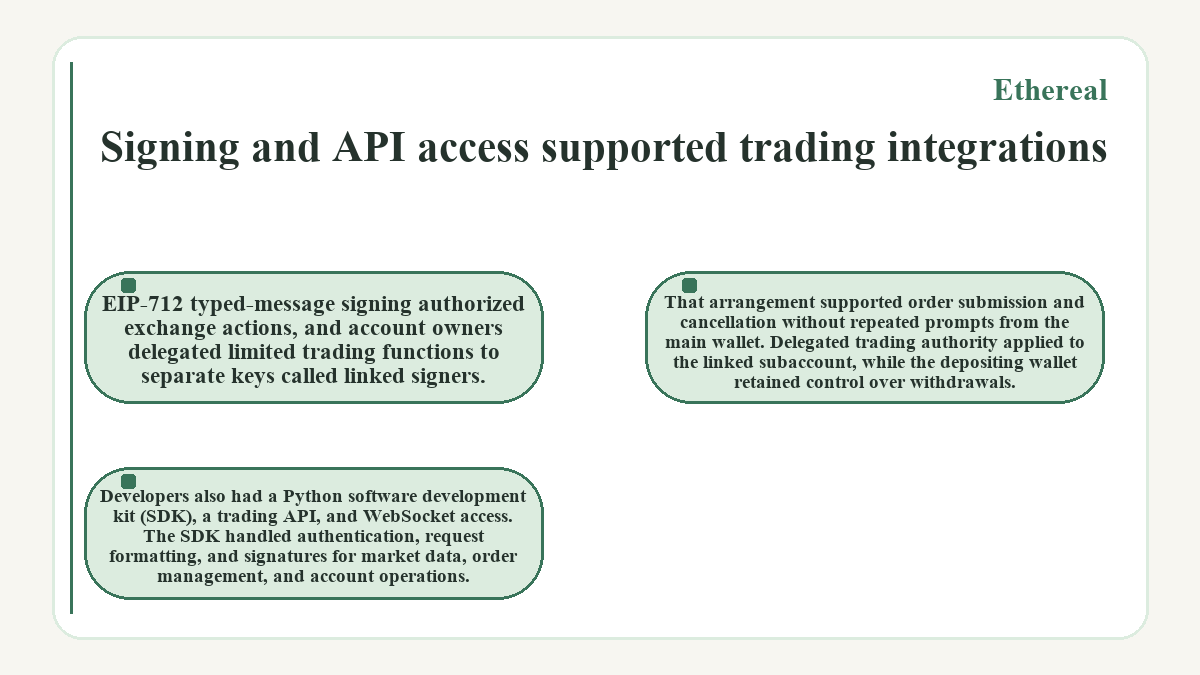
Developers also had a Python software development kit (SDK), a trading API, and WebSocket access. The SDK handled authentication, request formatting, and signatures for market data, order management, and account operations.
Reward points and the wider DeFi roadmap had separate scopes
Ethereal Points measured program activity separately from USDe reward distributions. Their calculations considered trading fees, open interest, liquidations, maker and taker volume, and referrals. A separate Ethena Exchange Points campaign specified an ENA distribution program based on authentic trading activity. Its announcement described a six-month campaign across 24 weekly epochs. That time-limited structure belonged to the campaign, not an indefinite entitlement attached to holding USDe or a perpetual position.
The wider product plan extended beyond perpetuals to spot trading, money markets, real-world assets, and other DeFi applications settled in USDe. Later announcements also described prediction markets within that ambition. These were development plans with their own release scopes. Their inclusion in the old roadmap doesn’t establish availability or identical terms within Meridian. A fresh trading decision concerns the successor’s available markets, collateral rules, and access conditions.
What to know about Ethereal
-
Can a limit order incur a taker fee on Ethereal?
- A limit order could incur a taker fee when it immediately matched liquidity already resting on the order book. The limit setting controlled price, while maker or taker status described how execution used liquidity. The original interface also supported post-only instructions for good-till-date limit orders, rejecting orders that would immediately match resting liquidity.
-
Why did deposits made midweek affect balance rewards differently?
- A deposit made partway through the measurement period contributed only for the time that the balance remained in the account. The reward calculation used the period’s average balance, so the closing balance alone didn’t determine the distribution. A larger late deposit couldn’t retroactively increase earlier snapshots.
-
Does a revoked linked signer become usable again?
- The original signer system didn’t allow a revoked signer to be linked again. Resting orders signed by the key had to be canceled before revocation, because the system checked signer authorization during onchain settlement as well as offchain order handling.
-
Could an ordinary sell order reverse a position?
- An opposite-direction order could reverse a position if its executed quantity exceeded the existing exposure. Selling more than an existing long position therefore could leave a short position. Reduce-only instructions addressed a different purpose by restricting execution to reducing exposure, without opening a position in the opposite direction.
-
Is the original mainnet chain ID also valid for the testnet?
- The original mainnet and testnet used different chain IDs: 5064014 for mainnet and 13374202 for testnet. Both listed USDe as the gas token, so the token name alone didn’t identify the environment. Wallet and integration settings needed to target the intended network.
-
How did Ethereal handle a funding charge that couldn’t be applied?
- The documented funding mechanism retried a failed charge during the first 15 seconds of the current hour. If every retry failed, it discarded that hour’s funding instead of applying it retroactively. This exception concerned technical failures in funding application.
-
Would offsetting positions across accounts always earn trading rewards?
- Accounts that opened offsetting positions specifically to game the reward calculation could be excluded from USDe Trading Rewards. The program’s eligibility conditions therefore included the purpose of that activity, alongside its position-holding rules.
updated